
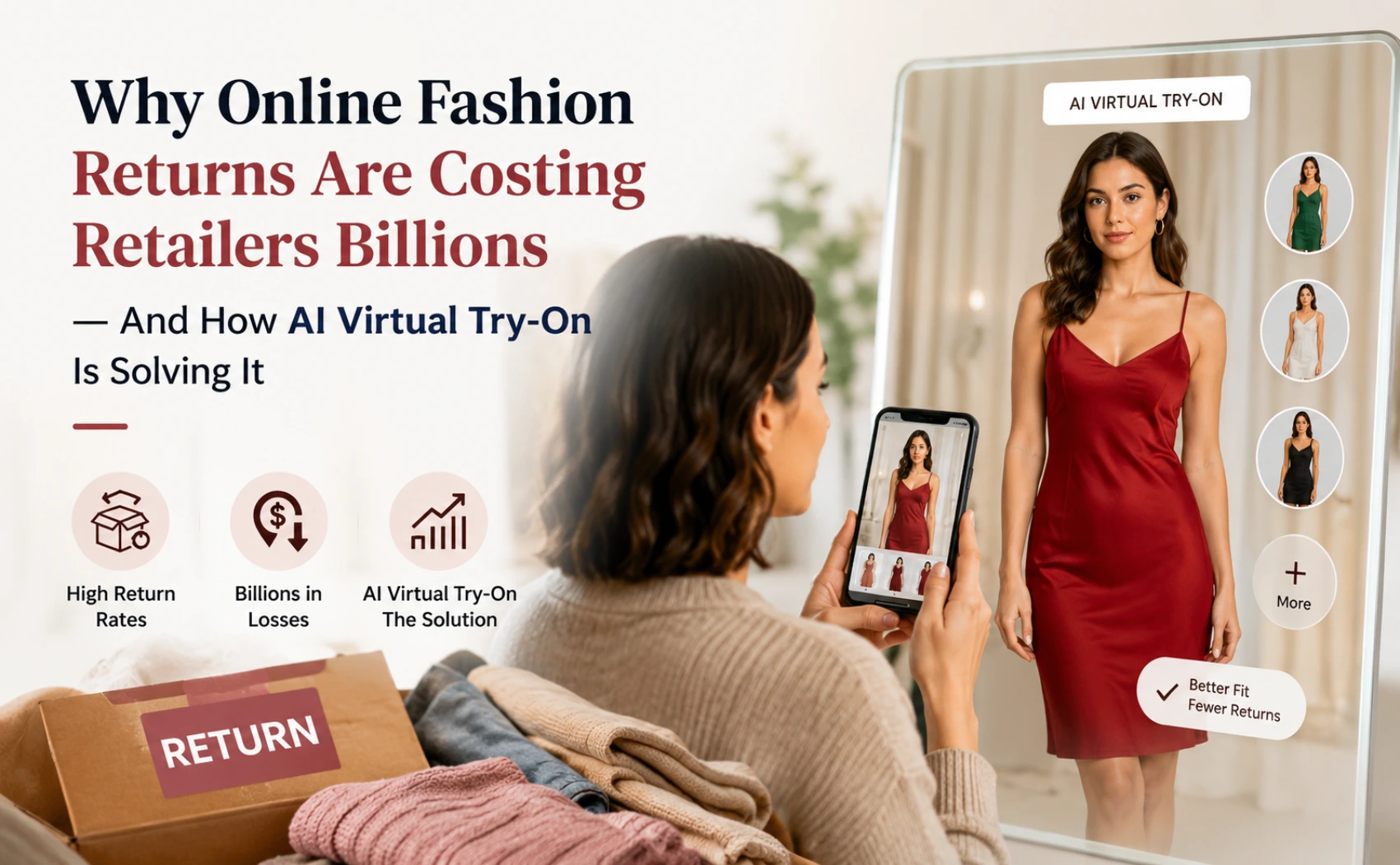
Imagine building your entire online fashion brand from scratch — designing collections, writing listings, running ads — only to have nearly one-third of every shipment returned to your warehouse. That is not a hypothetical scenario. It is the industry-wide reality of online fashion retail.
According to data published by the National Retail Federation (NRF) and Shopify, fashion and apparel consistently carry the highest return rates of any e-commerce category — typically ranging between 30% and 40% for online purchases. To put that in financial terms: U.S. consumers alone returned approximately $890 billion worth of merchandise in 2024 (NRF, 2024).
The uncomfortable truth is that most of these returns are preventable. The solution is not a more generous return policy or faster logistics. It is better product visuals — specifically, giving customers the same visual certainty online that they get when they walk into a physical store and try something on.
1. The Root Cause: Why Online Fashion Returns Happen
When a customer shops in a physical store, they pick up the garment, feel the fabric, hold it against themselves in the mirror, and try it on. Every tactile and visual input — texture, weight, drape, colour in natural light — helps them make a confident buying decision.
Online, none of that exists. You replace the entire in-store experience with a product image. And if that image is a flat-lay on a white background or a basic hanger shot, the customer has almost no real sense of how the garment will look on their body. They guess. They order. And when the delivery does not match their expectation, they return it.
What the data actually shows:
• Fit and sizing issues account for 40% to 70% of all apparel returns — the single largest driver. (Shopify Commerce Trends, 2024)
• Approximately 31% of online returns happen because the product 'did not look like the photo or description.' (Retail industry survey data, 2024)
• Processing a single return costs retailers 20% to 65% of the item's original sale value, when accounting for logistics, restocking, and potential depreciation. (Shopify, 2024)
2. The Confidence Gap — And Why It Is a Visual Problem
The core issue is what researchers call the 'intangibility gap' or 'confidence gap' in online shopping: the fundamental inability of customers to physically interact with a product before committing to a purchase. In fashion, this gap is especially wide because body fit is personal, fabric drape is invisible in flat lays, colour accuracy matters, and lifestyle context is missing.
The brands winning in online fashion are the ones actively closing this confidence gap — and the most efficient tool available to do that today is AI Virtual Try-On.
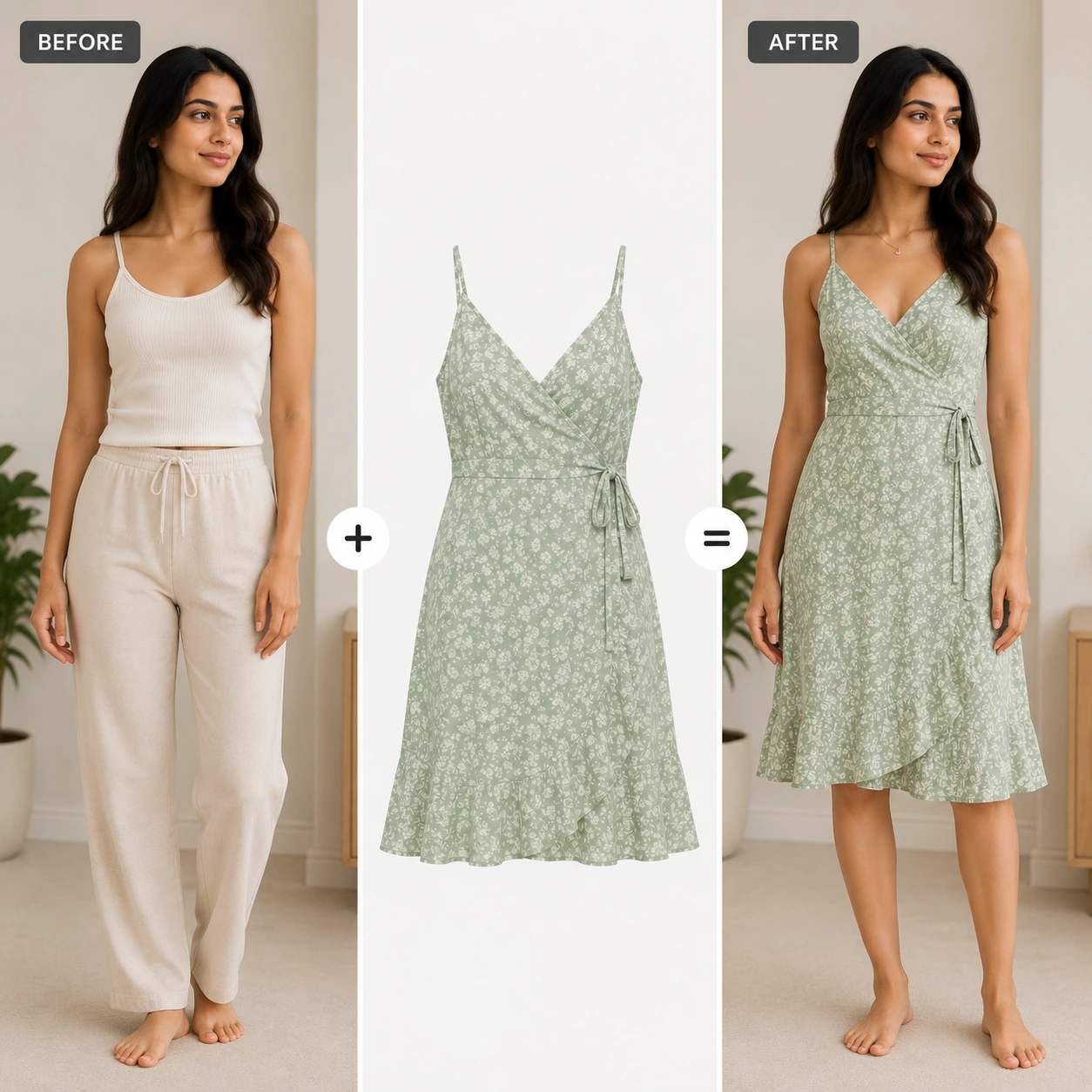
AI Virtual Try-On is a technology that uses generative artificial intelligence to realistically place a garment on a virtual human model. You upload a flat-lay image or product photo of the clothing item, and the AI maps the garment to a model's body — adjusting for fabric drape, body contour, natural shadows, and lighting — producing a photorealistic image that looks like a professional studio photograph of a model actually wearing the piece.
3. Google's Own Data on Virtual Try-On Effectiveness
Google's findings are drawn from organic shopping behaviour across millions of real product listings — not a controlled experiment. They reflect what happens when real customers are given the choice between a standard product image and a virtual try-on image:
• Virtual try-on product images in Google Search receive 60% more high-quality views than standard product listing photos. (Google, via Digital Commerce 360, 2024)
• Among shoppers who use Google's virtual try-on feature, 1 in 3 went on to make a purchase — a significantly higher purchase rate than those who engaged with standard images. (Google internal data, 2024)
• Snapchat's AR 'Image Try-On' feature delivered over 50 million fitting and sizing recommendations, contributing to a 24% decrease in product return rates for brands using the technology. (Snap Inc., 2024)
Fashion retailers implementing virtual try-on solutions have reported return rate reductions of 25% to 64%, depending on product category and depth of implementation. (BusinessWire and ResearchAndMarkets, 2024)
4. Beyond Clothing: AI Try-On for Accessories
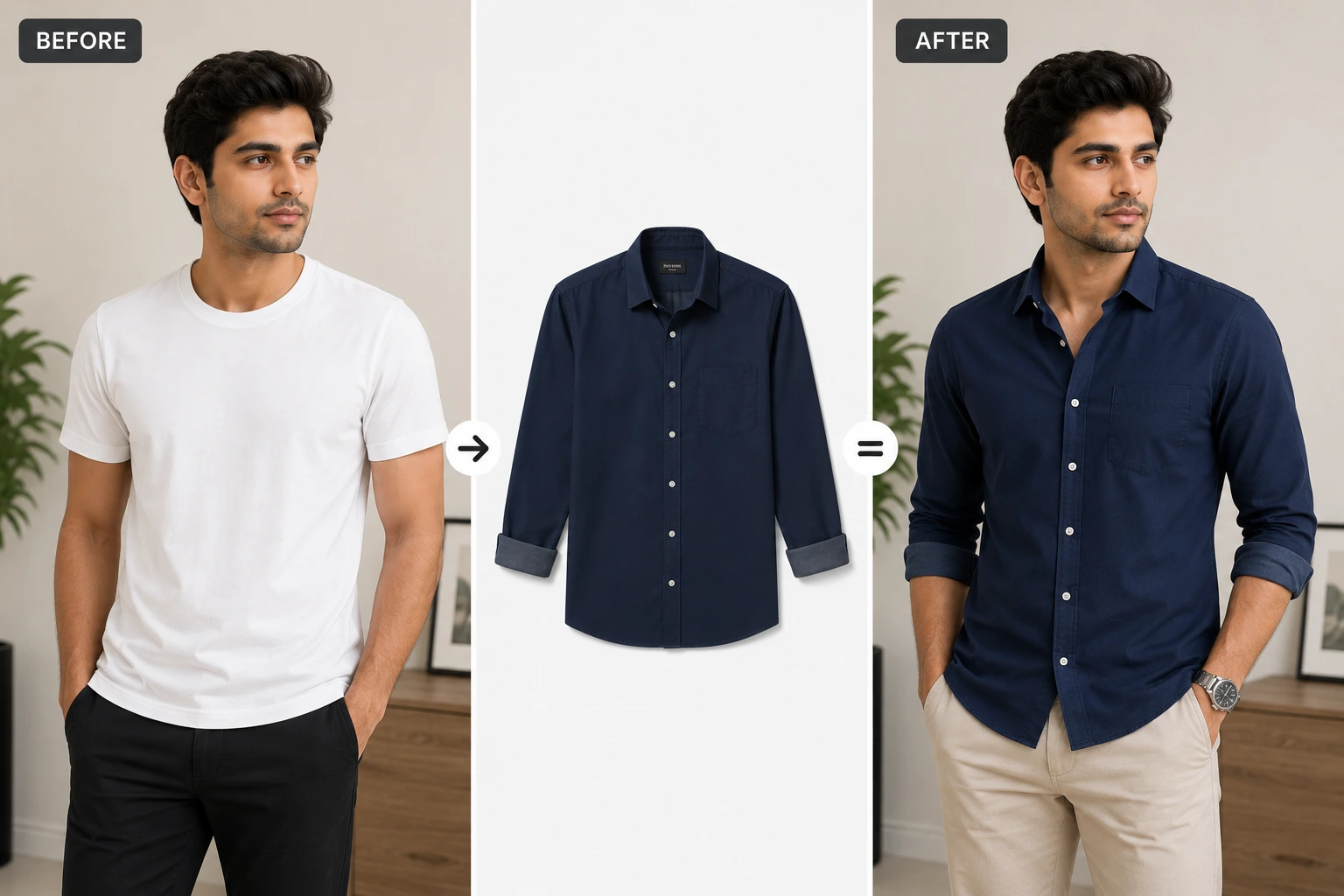
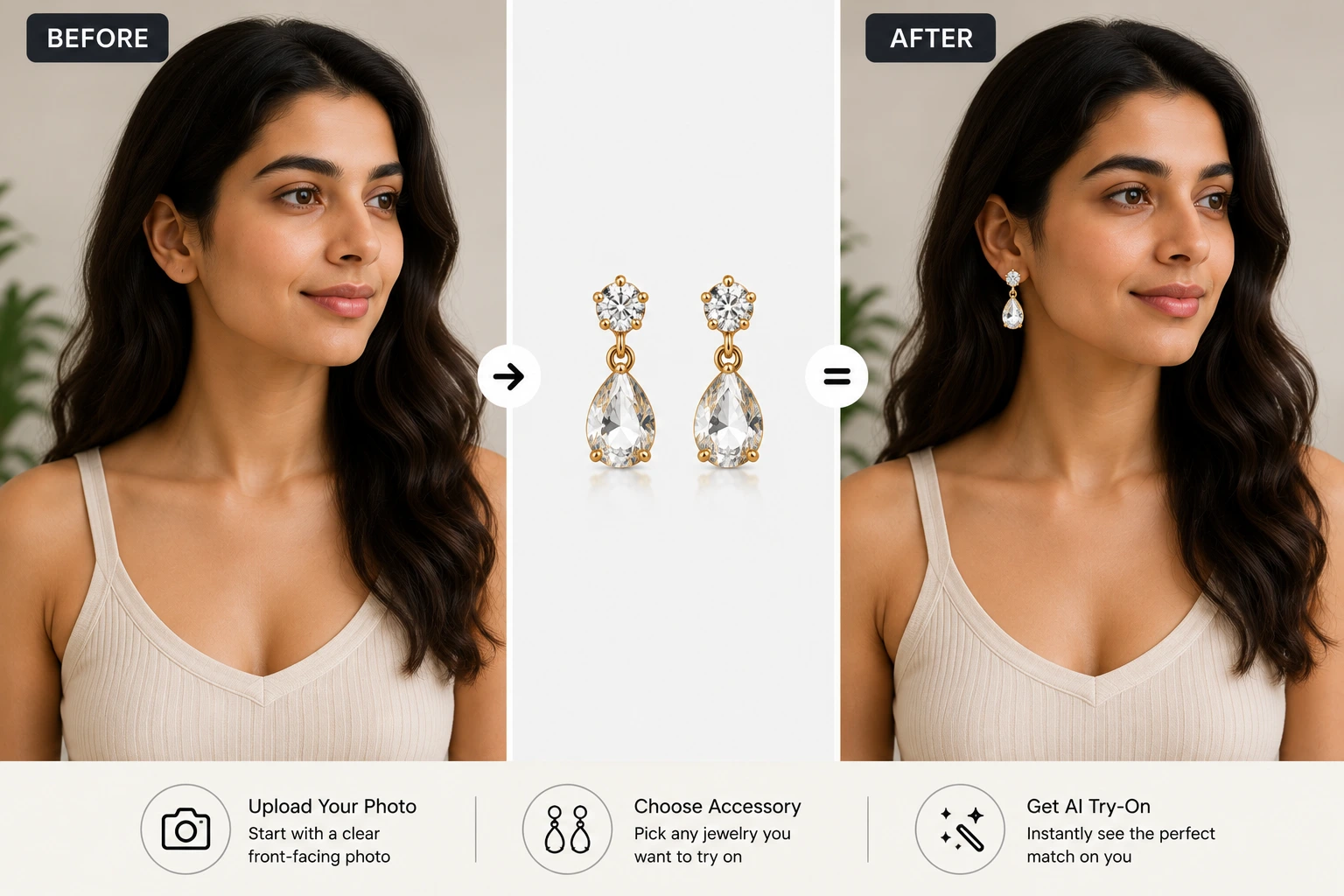
The confidence gap is not limited to clothing. Accessories — particularly earrings, necklaces, sunglasses, and watches — suffer from the same problem. A customer ordering a pair of statement earrings from a product image has almost no way to judge actual scale, how the piece hangs from the ear, or whether the proportions suit them.
AfterTaken's Accessories Try-On tool addresses this directly. Using AI, it realistically overlays sunglasses and eyewear with natural reflections and lens transparency, earrings and necklaces with correct scale and natural metal finish, watches mapped to a model's wrist with accurate proportions, and handbags positioned at the natural carry height.
For jewellery and accessories brands, this is particularly powerful. Traditional jewellery photography requires specialised macro lighting setups and significant post-production retouching. AI Accessories Try-On replaces that entire workflow.
5. A Practical Approach to Reducing Your Fashion Return Rate
Here is a step-by-step approach to implementing AI try-on and using it to directly lower your return rate:
Step 1 — Identify Your Highest-Return Products: Audit which SKUs have the highest return frequency. Check your return request notes. If common themes include 'looked different in real life' or 'fit was unexpected,' you have a visual confidence problem AI try-on can address.
Step 2 — Start With Your Top Sellers: Begin with your 10 to 20 best-selling items — especially those with high return rates. Replace flat-lay or hanger images with AI try-on images. Monitor the impact over 30 to 60 days.
Step 3 — Address Colour Accuracy: If your product images suffer from colour inaccuracies, use AfterTaken's AI Photo Color Correction tool to correct colour casts before generating try-on images. A colour-accurate base ensures your on-model output is true-to-life.
Step 4 — Generate Multiple Model Variants: Generate the same garment across models of different body types and skin tones. Showing your product on a diverse range of models gives customers multiple visual reference points and increases purchase confidence.
6. The Growing Market: Where Virtual Try-On Is Headed
The global virtual try-on market is projected to reach between $27 billion and $48 billion by 2030–2031, growing at a significant compound annual rate. (BusinessWire and ResearchAndMarkets, 2024)
The trajectory is clear: virtual try-on has moved from an experimental feature to a mainstream expectation — particularly among Millennial and Gen Z consumers, for whom interactive, visual shopping experiences are the standard, not a novelty.
Brands implementing AI try-on today are building a structural competitive advantage: lower return rates translate directly into higher net margins, reduced customer service load, and fewer products that must be restocked, discounted, or written off.
Conclusion
A 30% to 40% online fashion return rate is not an inevitable cost of doing business. It is the measurable outcome of a confidence gap that AI Virtual Try-On directly addresses. By giving customers photorealistic, on-model visuals before they purchase, you eliminate the single biggest driver of returns: the gap between what a customer expects from a product image and what they receive when the package arrives.
The data from Google, Snap, NRF, and Shopify all point in the same direction: on-model and AI try-on visuals generate more views, more purchases, and significantly fewer returns than standard flat-lay or hanger images.
For fashion brands of any size — from independent boutiques to high-volume marketplace sellers — AfterTaken's AI Virtual Try-On and Accessories Try-On tools make this level of visual quality accessible without expensive photoshoots, model bookings, or post-production editing.